Understanding School Budgets: Why Trustees Sometimes Have to Make Impossible Decisions
- Melissa C. Baxter
- Jul 19
- 4 min read

Every year, the Province announces billions of dollars for education.
Most people hear those announcements and think:
"Great! Schools must finally have enough money."
Unfortunately, it doesn't work that way.
The reality is much more complicated.
One of the biggest misconceptions about School Trustees is that they decide how much money schools receive.
They don't.
Instead, Trustees receive a funding envelope that has already been largely determined by the Province.
Their job isn't deciding how much money they get.
Their job is deciding how to make the best use of the money they have.
Think of it like your household budget
Imagine your family earns $5,000 per month.
Now imagine that every year:
groceries cost more
hydro increases
insurance goes up
your mortgage rises
gas costs more
your children need more things
But... your income only increases a little.
Eventually, something has to give.
You don't stop loving your children.
You simply can't afford everything anymore.
That is very similar to what school boards experience.
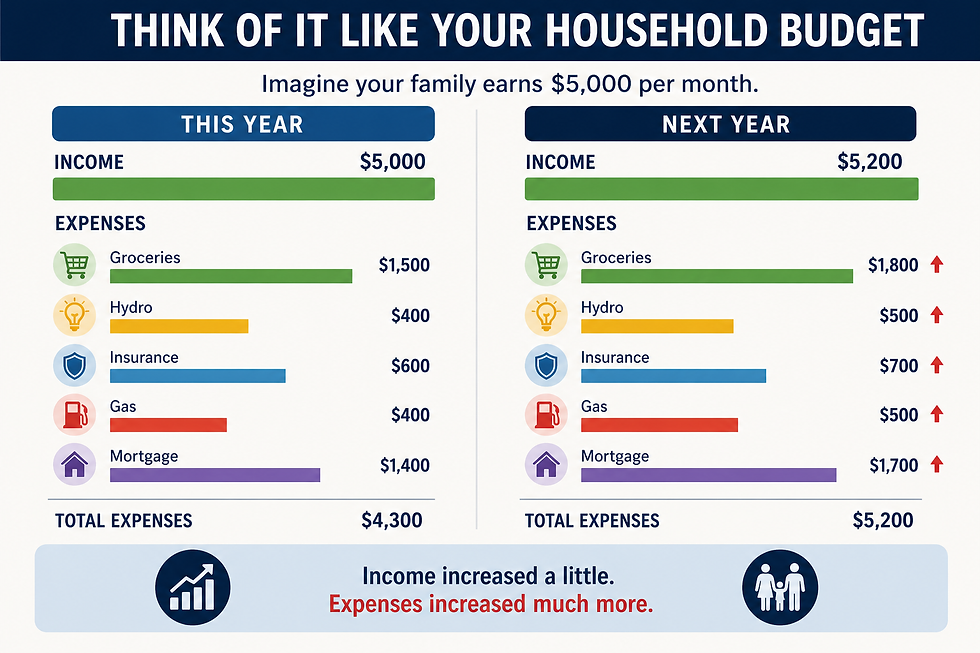
Income increased a little.
Expenses increased much more.
Where Does School Board Money Come From?
Many people believe HWDSB collects taxes and decides how much money schools receive.
That's actually not how it works.
Most school funding comes from the Province.
The Province decides:
how much each board receives
how the money is calculated
which funding is restricted
what formulas are used
School Boards cannot simply increase local education taxes if they need more money. That authority rests with the Province.

So What Do Trustees Actually Do?
This surprised me when I first began researching school board governance. Many people picture Trustees sitting around a table deciding:
"Let's spend another $10 million on Special Education."
That's not how budgeting works.
Board staff spend months preparing a proposed budget.
They calculate things like:
expected student enrolment
staffing requirements
transportation
utilities
building maintenance
technology
salaries
inflation
government funding
contractual obligations
That proposal is then brought to Trustees.
ask questions
challenge assumptions
request changes
understand trade-offs
vote on the budget
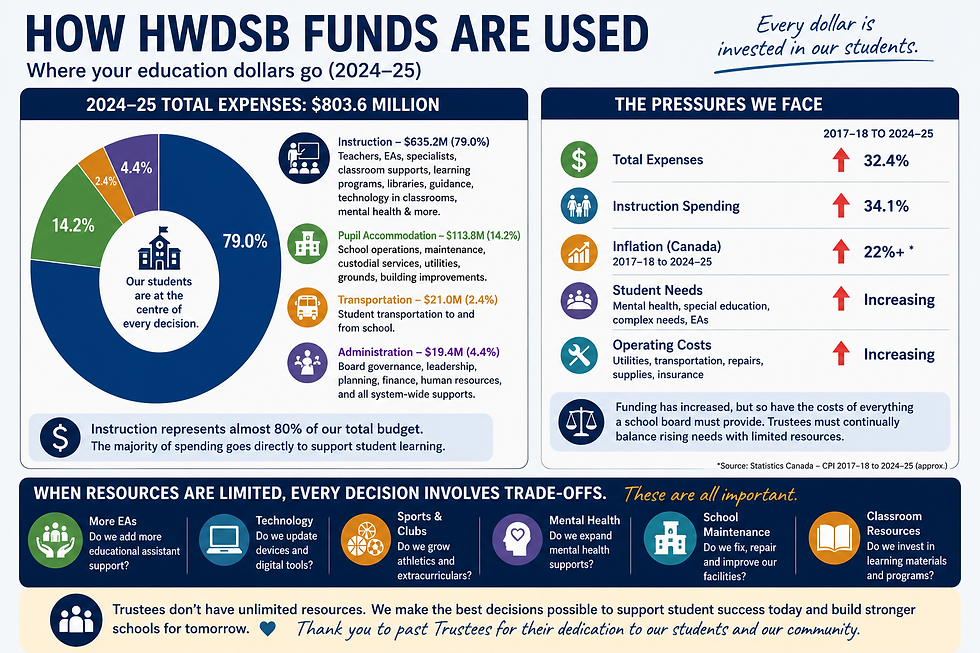
Why do Parents Feel Services Are Being Reduced?
This is where things become frustrating.
Looking at eight years of public audited financial statements, I found something interesting. The Province has not simply given HWDSB less money every year.
In fact, total funding has generally increased.
So why does it feel like schools have less?
Because costs have also increased. Sometimes dramatically.
Think about everything that has become more expensive over the last eight years:
wages
benefits
electricity
natural gas
insurance
transportation
building maintenance and repairs
technology
supplies
student mental health supports
special education needs
Even if funding increases... those cost increases can consume the additional money.
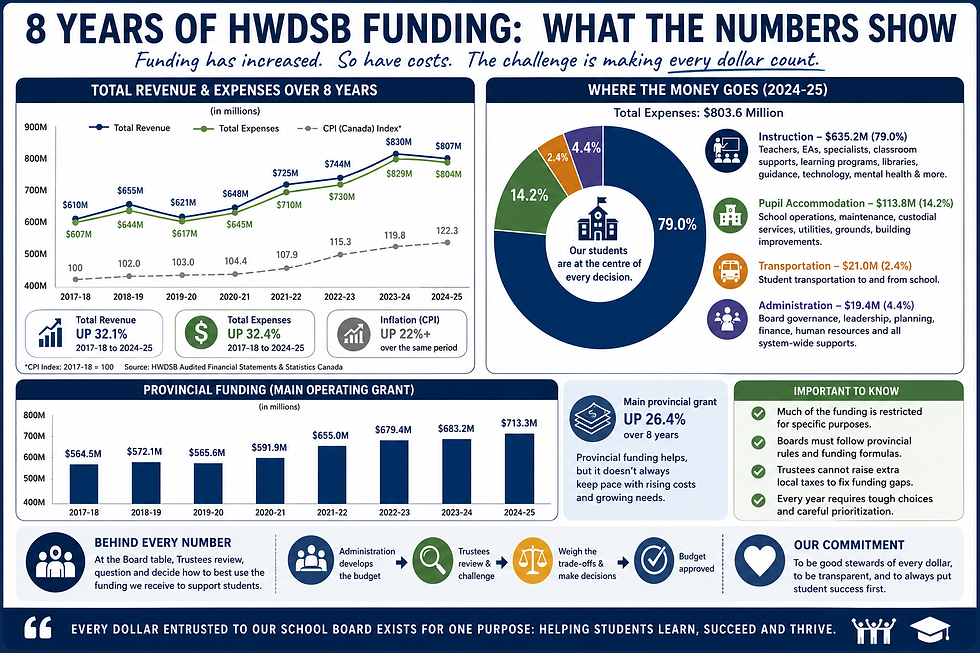
Funding increased. So did costs, and in many cases, they increased even faster.
The Numbers
Looking at HWDSB's audited financial statements:
School Year | Total Revenue | Total Expenses |
2017–18 | $610M | $607M |
2018–19 | $655M | $644M |
2019–20 | $621M | $617M |
2020–21 | $648M | $645M |
2021–22 | $725M | $710M |
2022–23 | $744M | $730M |
2023–24 | $830M | $829M |
2024–25 | $807M | $804M |
At first glance, that looks like great news. Revenue increased by almost $200 million.
But so did expenses.
By the end of the year, there wasn't a giant pile of extra money sitting in the bank. It had already been spent operating schools.

Very close together.
Every year.
A New Appreciation for Previous Trustees
The more financial reports I read, the more respect I developed for previous Boards of Trustees. No matter who was sitting around that table, they weren't deciding between good ideas and bad ideas. They were deciding between many good ideas and limited resources.
Do we hire more Educational Assistants?
Replace aging technology?
Repair a school roof?
Expand mental health supports?
Improve accessibility?
Increase classroom resources?
None of those are bad investments. But sometimes there simply isn't enough flexibility to fully fund everything.
That doesn't mean every decision was perfect.
It means the decisions were often far more difficult than many people realize.
Looking Back Helps Us Look Forward
This is where I think Trustees can make a difference.
Budgets shouldn't just be approved and forgotten. They should also be studied.
If a department has consistently struggled for years... why?
If Special Education has experienced growing pressures... what can we learn?
If technology keeps falling behind... what should change?
Past budgets help us make smarter future budgets.
My Commitment
If elected, I want budget discussions to be easier for families to understand. Parents shouldn't need an accounting degree to follow where education dollars go.
I believe every major budget decision should answer three simple questions:
What problem are we trying to solve?
How will this help students?
How will we know if it worked?
Because every dollar entrusted to a school board ultimately exists for one purpose:
Helping students succeed.
What's Next
This research also revealed important gaps.
While the audited financial statements show the big picture, they don't show exactly how much was spent each year on Educational Assistants, classroom technology, athletics, mental health, or individual departments.
That's why my next step is to examine detailed budget documents, staffing reports, and committee reports. I want to better understand how funding decisions have changed over time and where pressures have grown. My goal isn't to assign blame. It's to learn from the past so we can make more informed decisions for the future.
If elected, I will bring this historical perspective to every budget discussion. Understanding where funding pressures have existed in the past can help Trustees ask better questions, make more informed decisions, and give every department thoughtful consideration based on current needs, available evidence, and the resources we have.
Every budget tells the story of what we value. My goal is to help ensure those decisions are informed, transparent, and always focused on what matters most, our students.
-Melissa


Comments